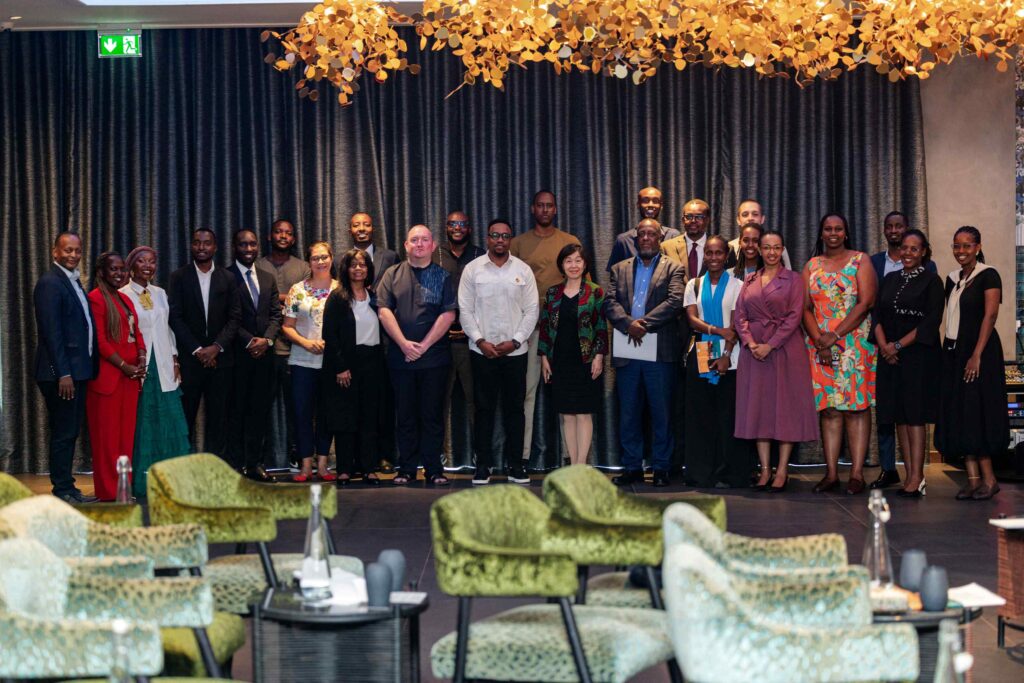
High-Level Consultative Meeting Calls for Structured Action to Unlock Rwanda’s Creative Economy
Government officials, development partners, financial institutions and leading creatives convened at The Pinnacle Kigali for the presentation of the ArtsConnekt Needs Assessment, a study examining structural gaps within Rwanda’s creative economy and outlining practical recommendations for sector
growth.
The consultative meeting was attended by Dr. Brave Olivier Ngabo, Permanent Secretary at the Ministry of Youth and Arts, alongside representatives from UNDP Rwanda, the African Development Bank (AfDB), the Development Bank of Rwanda (BRD), Rwanda Arts Council, the British Council and stakeholders in the creative industry.
The assessment [DOWNLOAD LINK], conducted by Green Horizon Ventures (GHV) and Creative Visions Foundation (CVF), surveyed 245 creatives and programme participants across the country.
Key Findings
56% of surveyed youth have never received formal training
Significant disparities between urban and rural creatives
Limited entrepreneurial and digital marketing capacity
Financing barriers linked to structural and documentation requirements
High demand for equipment and production infrastructure
Presenting the findings, Pat Chandler, CEO of Creative Visions Foundation (CVF), said the
assessment provides structured evidence to support long-standing sector concerns.
“This assessment validates the lived realities of creatives. Rwanda does not lack talent
— it lacks structured systems around that talent. The recommendations focus on
practical interventions: strengthening entrepreneurial skills, improving access to finance
through better-prepared proposals, expanding equipment access, and building stronger
market linkages.”
Co-presenter Adam Bradford, CEO of Green Horizon Ventures (GHV), emphasised that
bridging the gap between creative ambition and financial structure is critical to
unlocking sustainable investment.
“There is capital available. The challenge is alignment — aligning creative vision with
financial discipline, documentation and measurable impact. When creatives can speak
the language of structure and numbers, access to finance becomes far more realistic.”
Reacting to the findings, filmmaker Eric Kabera underscored the importance of
institutional maturity within the industry.
“The talent has always been here. What this assessment makes clear is that we must
now build the systems — skills, infrastructure and market pathways — that allow that
talent to compete regionally and globally.”
Multidisciplinary artist Delah Dube highlighted the importance of market literacy and
cross-sector collaboration. “Creatives must understand not only their craft but their market. Strategic positioning, partnerships and cross-sector collaboration are essential if we are to build sustainable
creative enterprises.”
Financial institutions echoed the need for structure. BRD highlighted the importance of
sub-sector segmentation to inform tailored financing models, while AfDB emphasised
that proposals must be precise, costed and data-driven to attract investment.
In his remarks, Dr. Brave Olivier Ngabo, Permanent Secretary at the Ministry of Youth
and Arts, situated the discussion within Rwanda’s broader development agenda.
“Under NST2, we are targeting the creation of 250,000 jobs. The creative sector is one
of the areas where these jobs can be generated if we structure it properly.”
He acknowledged the persistent communication gap between creatives and financiers.
“The real challenge is how we bridge the two languages — talent on one side, finance
and structure on the other.”
Dr. Ngabo also highlighted ongoing government efforts to strengthen intellectual
property protections, reinforce Collective Management Organisations for fair royalty
distribution, expand creative spaces and restructure the Rwanda Arts Council in
collaboration with UNESCO to better align skills development with labour market needs.
“No single session can transform the sector alone. What we are building is not an event
— it is an ecosystem,” he concluded.
The ArtsConnekt initiative now moves into its implementation phase, with partners
refining structured interventions aimed at strengthening entrepreneurial capacity,
improving access to finance and enhancing national and international market linkages.